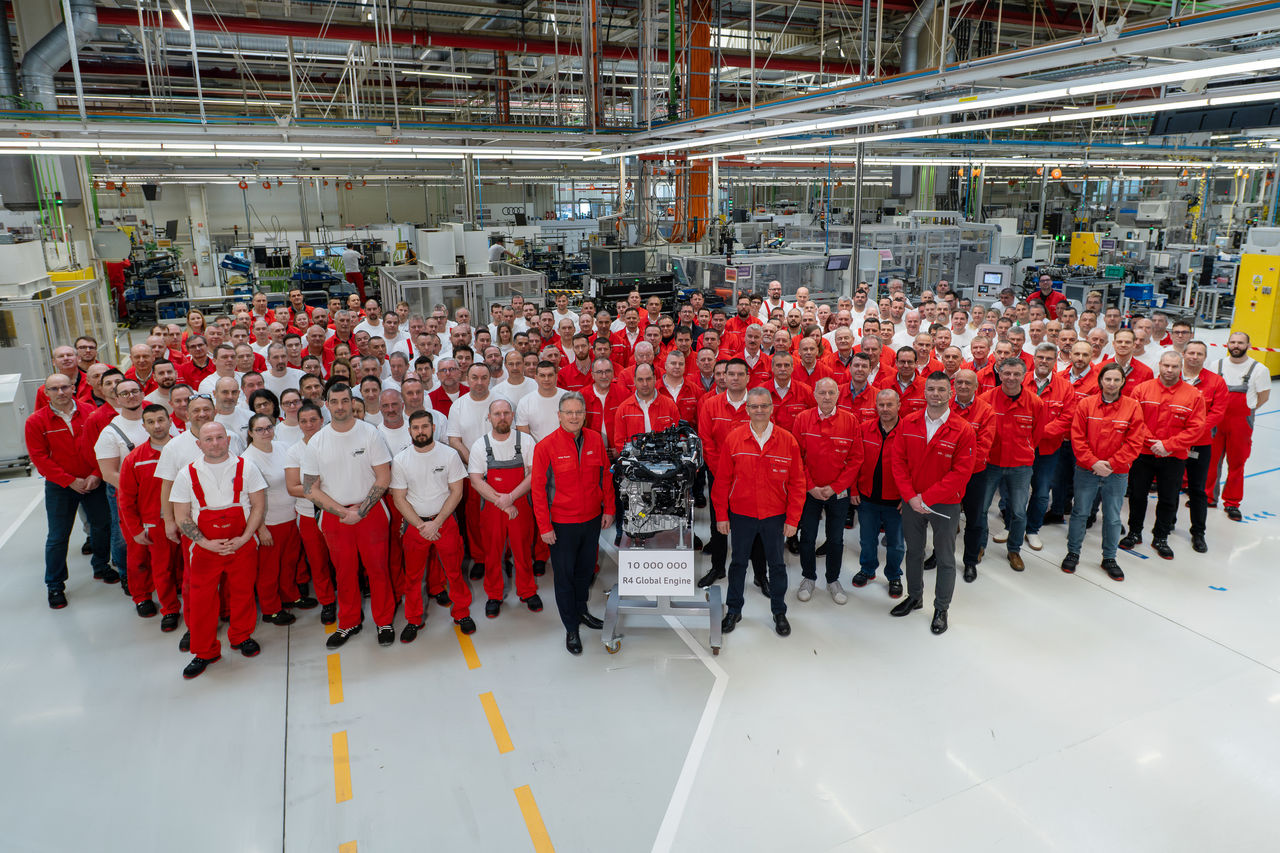
To mark the jubilee, we spoke to our employees, who represent different areas of our company and work alongside 1,100 other colleagues to ensure that our EA888 power units are proving their worth in millions of vehicles around the world every day.
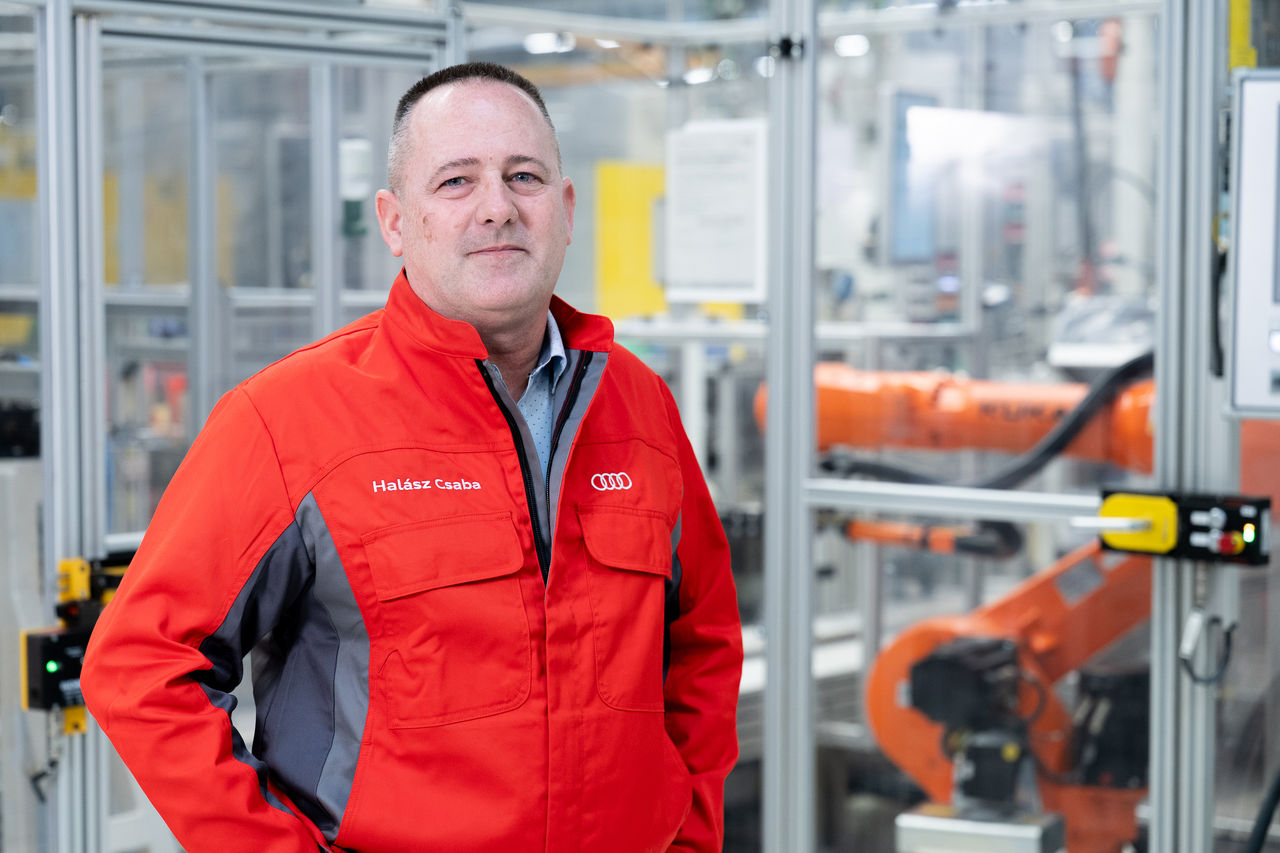
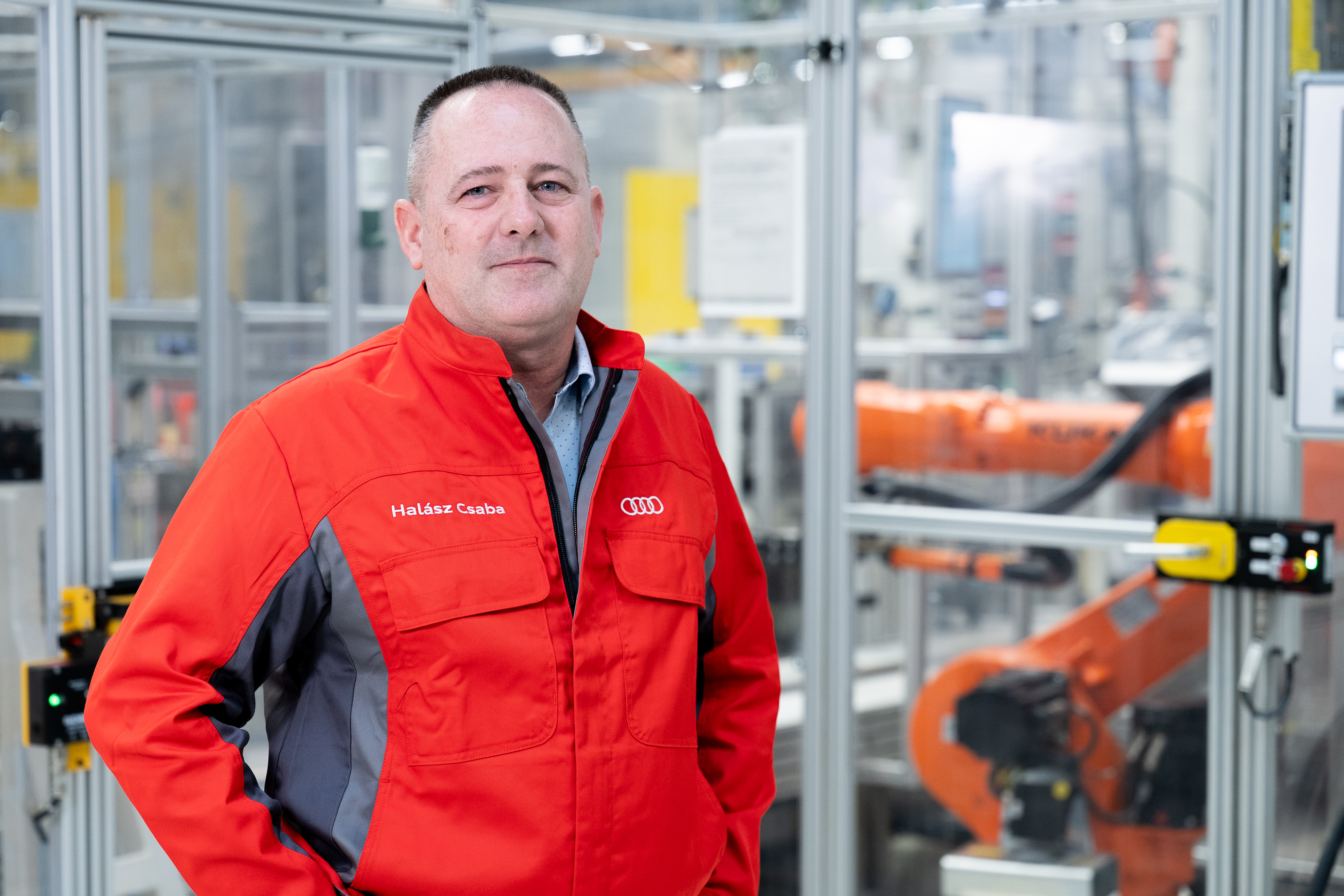
Csaba Halász arrived at Audi Hungaria in 1996, and it is fair to say that his career with the four rings has been accompanied by the product, initially as a cylinder head assembler and then as a production time analyst. Later, as an AP engineer, his task was to standardise assembly processes, so he knew every small detail of the production line inside out. For almost a year and a half, he has been part of the production planning team and speaks highly of production from this perspective as well.
"Over the last 20 years, we have integrated 5 generations on the production line, of which we currently produce three generations of powertrains, GEN3, EVO4 and EVO5, which in itself shows the complexity of our work. Since the launch of the power unit in 2005, we have integrated every next generation into the continuously operating production line by making the most of every summer and winter shutdown so far. So, this is an area where we plan ahead for up to a year, even a year and a half, of rebuilds."
Engines have become more complex with each generation, with more and more components, and as manufacturing technology has evolved, the manufacturing infrastructure has changed and is changing with the incorporation of new innovations.
"In the past, with the increasing adoption of robotisation, the integration of robotic cells in the production line was a major challenge. We have tried to use robots for moving heavy parts, for cyclical, monotonous bolting tasks, for non-value-added tasks, to make better use of our staff's expertise. As a production planner, my tasks also include finding the optimal ergonomic, occupational safety and automation solutions, and keeping up with the development of technology myself."
When we asked Csaba about his feelings regarding the engine on the occasion of the jubilee, he took off his glasses and talked about the many good people he has worked with over the years.
"This production line has accompanied the life paths of many people. We are talking about a success story of more than 20 years, which for me is a symbol of continuous development. For me, the most important thing is that we feel the line and the product are our own, and that we put our hearts and souls into our collective work."
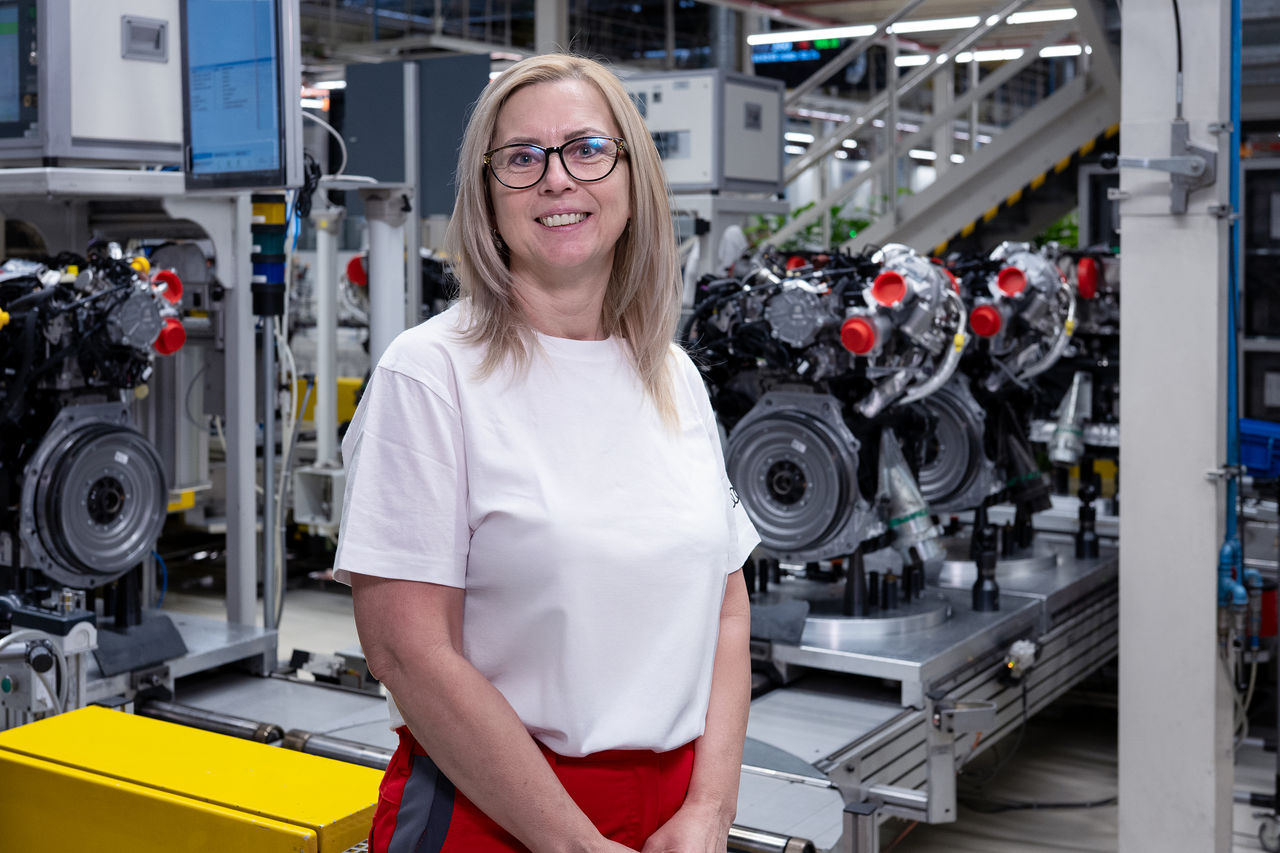
Since her arrival in 2017, Brigitta Üveges has contributed to the EA888 becoming a globally recognised engine in the engine assembly shop. One of Brigi's tasks is to check the finished engines, as all the connecting plugs, tubes, cables, clips and gaskets have to be in place.
"When I started working here, we were still producing Gen3, but now Evo4 and Evo5 are the high volume engines. These consist of many more parts and therefore require more workstations on the production line. Every stage of the work is equally important during the inspection, so no mistakes can be made. I would highlight the Control PC process, though, as this is a final visual inspection where we can see that all the production processes have been completed flawlessly on the production line.
Brigi speaks very warmly of her colleagues, who are always there to support her and they stick together like a family.
"When we complete the production count without errors during a shift, you can see the harmony and the teamwork, and I feel proud every time. It makes me particularly proud that the power unit we have created has reached such a beautiful jubilee, as I can also contribute to this great achievement."
The precision of Audi Hungaria's engine plant in Győr is also outstanding at Group level, thanks to strict quality assurance standards, fault prevention systems, such as Poka Yoke and automated checks.
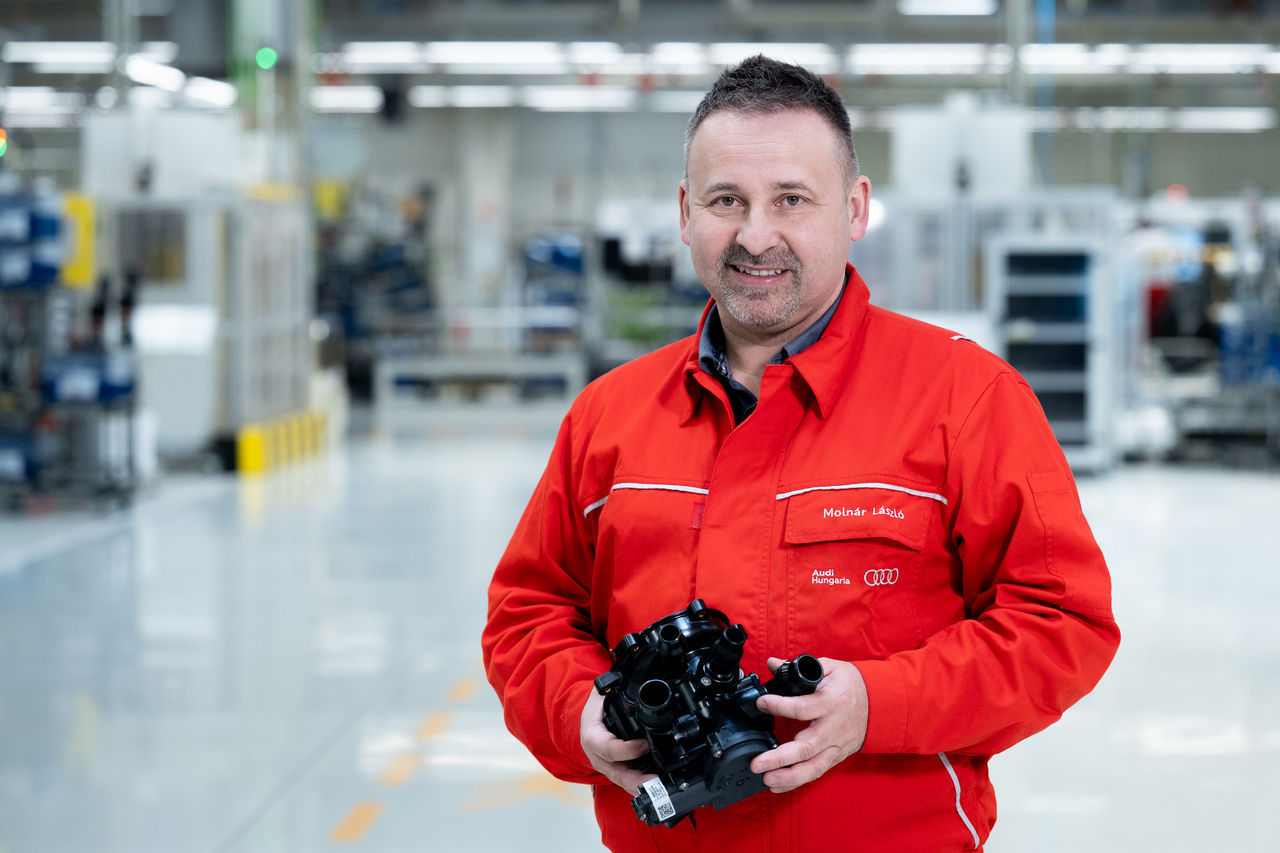
And what does ‘flawless’ mean for an EA888 engine? László Molnár, coming from the field of quality assurance, gives us an excellent summary.
"It means that when we put the engine together, all the parts work as the designers intended. There is no compromise, no minimum and no maximum. It's durable, reliable, consistently meets emissions requirements and, just as importantly, every single piece is of the same standard."
László has been working in quality assurance since January 2000, and has been involved in the EA888 engine family from the ground up, starting with the trial production of the engine in 2005. The passage of time is perhaps even more evident in the fact that his two young sons, born in the meantime, have now well entered their teens.
“I consider it a privilege to have been able to support our product from the quality assurance side since the very beginning. The key to this long success story of continuous improvement is clearly consistency. We stabilise both our own processes and those of our suppliers, with constant feedback towards both our suppliers and development, so this consistent work is the basis for quality. There is no big secret, we expect the same level of performance from ourselves every day."
László speaks with fantastic enthusiasm and equal dedication about the need for quality, which he sees not as a one-off goal but as an ongoing task. This gives the kind of stability he can rely on when working with millions of pieces.
"A seemingly small detail, a minor discrepancy or an unclear component drawing can lead to a fault that may be caused by systemic problems. Therefore, a thorough analysis and calm decision making is needed in each case to identify them. In all cases, we rely on data, act in a well-founded manner, because serious analysis is needed to make quick and effective corrective decisions, which will not have to be made next time if we learn from our experiences. I believe that the essence of the whole lies in the details."
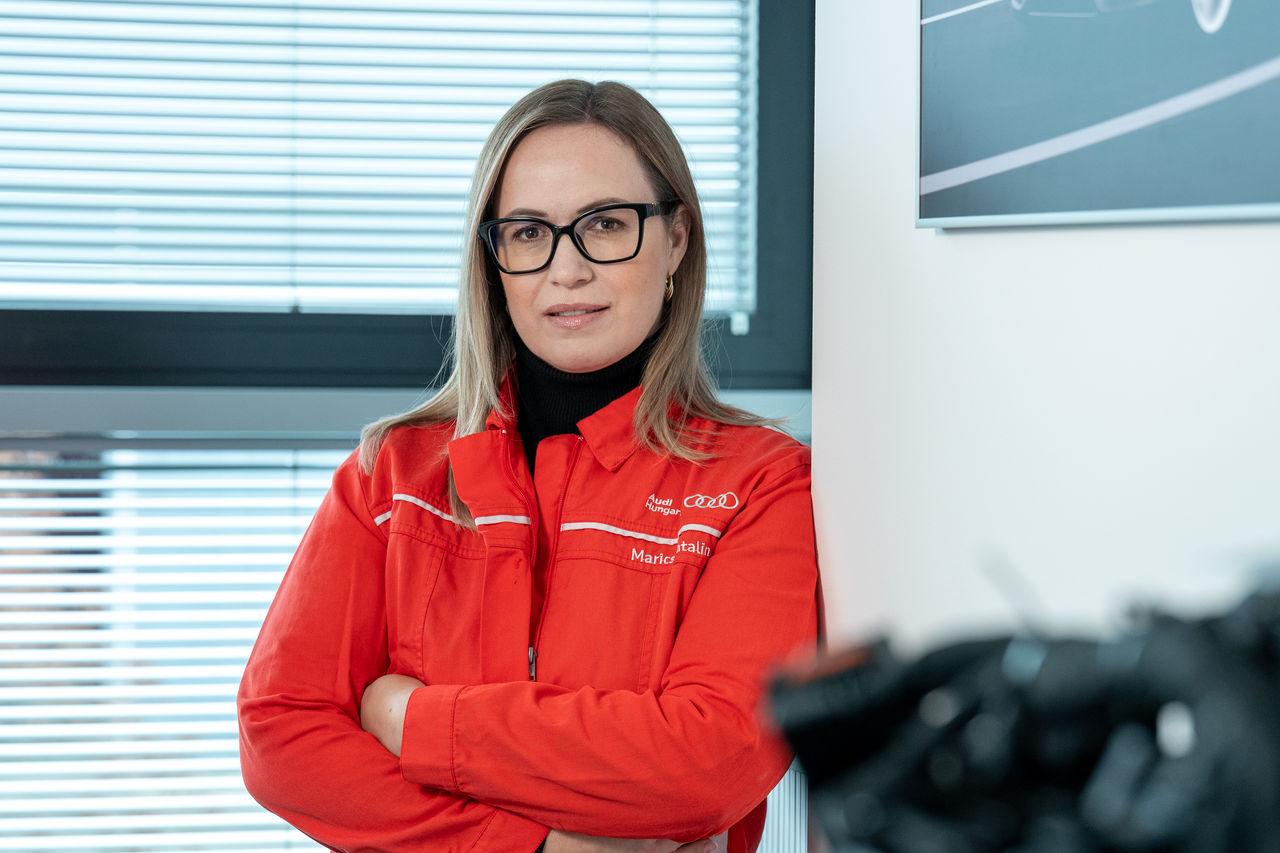
And in the case of the EA888, the big picture – at least from a logistical point of view – is certainly the whole world, as 30 different engine models are shipped all over the world – from Mexico through South Africa to Malaysia – and they have to coordinate more than 1,100 purchased parts and mechanical components, with Katalin Marics as the technical coordinator.
"The logistical management of the EA888 engine series is an extremely complex task, in which the engine program design and engine delivery teams, as well as the disposition and mechanical program design teams, play a very important role. This engine series logistics is also unique in that we are not only responsible for the demand and capacity of the European powertrain production, i.e. in Győr, but also for the coordination of the EA888 engine plants in Mexico and China. In total, we coordinate the logistics of six production sites. If there is a capacity shortage at group level, our colleagues control and allocate the available capacity to the plants around the world. We currently supply nearly 600 engine parts from Győr to the world."
This work is often extremely challenging for colleagues, who often have to deal with global externalities in their work. In recent years, we have had to deal with a number of unexpected force majeure events: extreme weather, ship delays, supplier floods and fires. In the meantime, supply chains have also changed, requiring close coordination between several areas – development, quality assurance, production, logistics.
"We now work with well-established tracking systems and use alternative routes or suppliers when necessary. We work like a well-coordinated machine: the 'cogs' turn together despite all the difficulties, so that the production line can keep running and customers get their engines on time."
While we are celebrating the 10 millionth EA888 from Győr this year, the combined volume from Győr, Mexico, China and India reached the 30-millionth power unit last year. For me it is a great pride to reach this milestone and I am very happy to have been part of it. During my past 13 years here, I have supported the P4, or four-cylinder petrol engine segment in a number of roles, working with the team to ensure that the parts needed for production are available on time and that our customers are fully served. I believe that 10 million engines completed is not just a number, it is a collective achievement of Audi Hungaria and a significant milestone in the company's history."